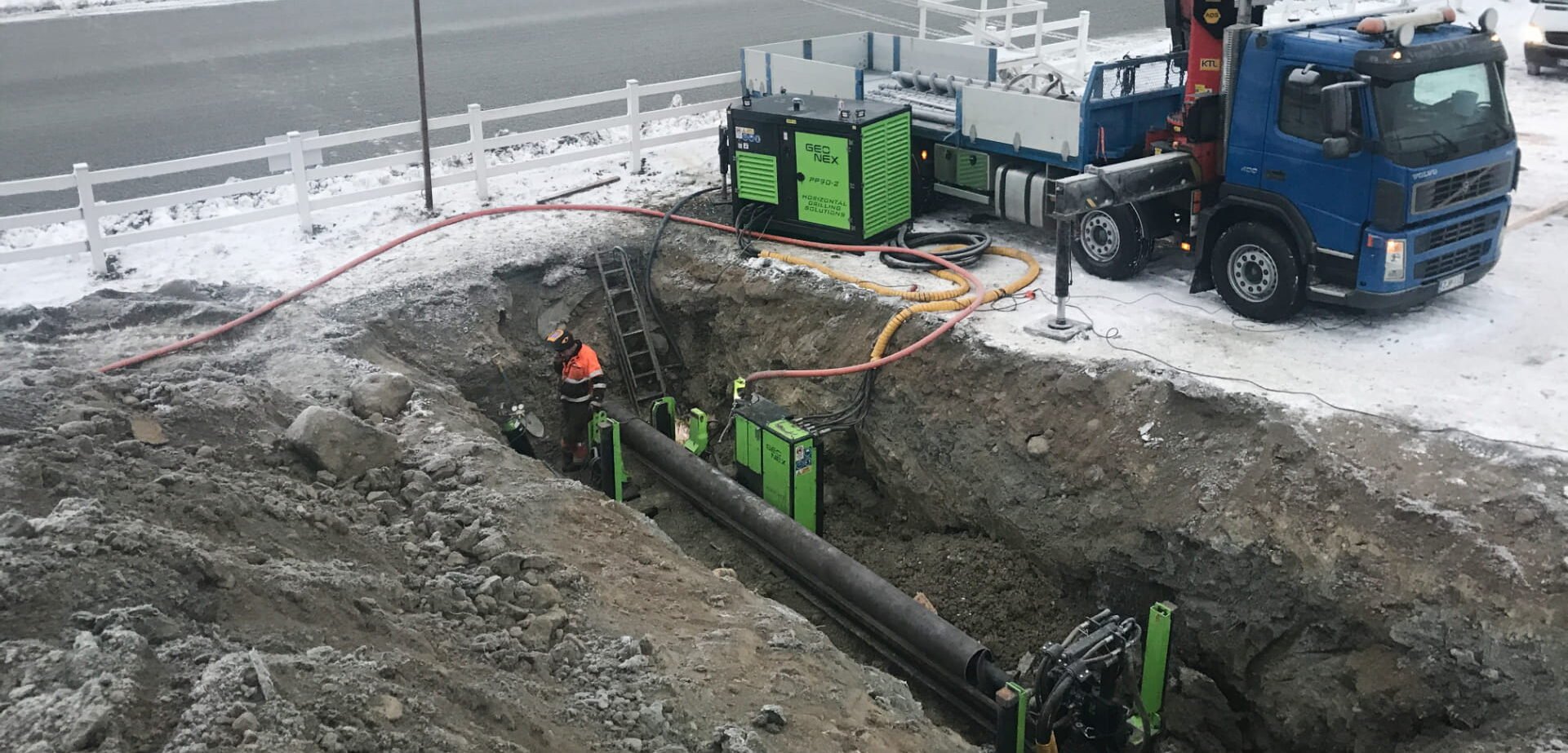


Challenging Scandinavian ground conditions have driven innovation—Horizontal Hammer Boring (HHB) has emerged as an effective trenchless solution.
Advancing Underground Installations: The Evolution of HHB Technology in Scandinavia
Effective solutions for installing small-diameter tunnels through solid rock, broken rock, and difficult soft ground are rare, but they do exist. We discuss here the development of Horizontal Hammer Boring (HHB) technology in Scandinavia over the last 30 years.
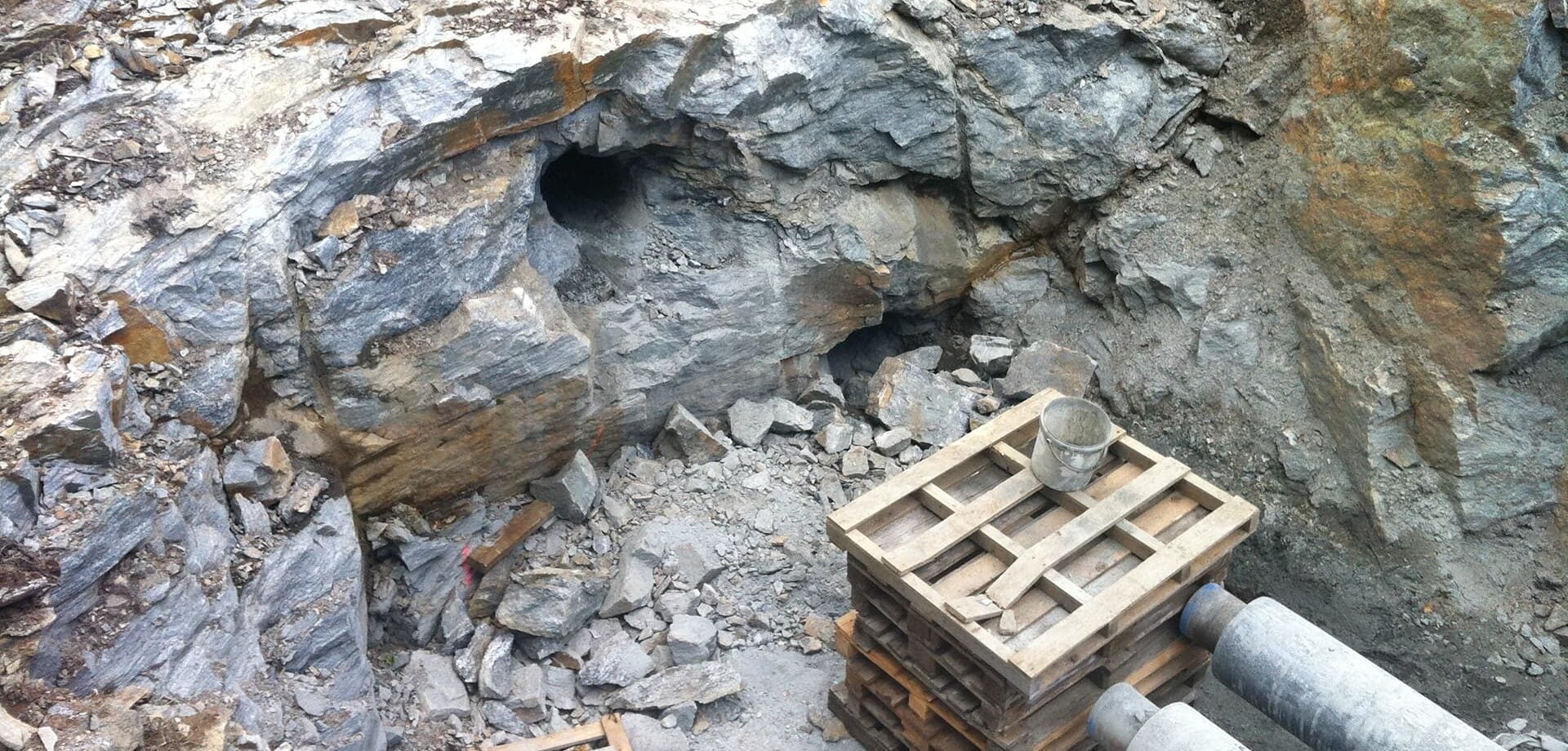
Scandinavian ground conditions can be extremely onerous requiring utilities to be installed through hard rock and soft ground littered with boulders that has forced contractors to think out of the box to find reliable cost-effective solutions to install underground ducts.
Pneumatic hammer well drilling technology from the 1950s commonly referred to as Down-The-Hole (DTH) hammers provided a solution. Driven by compressed air the hammer mechanism has a fairly simple rapidly reciprocating piston arrangement that percussively strikes a drill head assembly 2 to 10 times per second to generate massive percussive impact energy that disintegrates and drives through the ground. Exhaust air from the piston is directed through the drill head to flush spoil cuttings to the surface.
Pioneering Horizontal Hammer Boring for Efficient Trenchless Construction
Pentti Juvani, father to sons Kai and Kimmo from Boreal Star Oy, a family- owned Finnish contracting company, adopted DTH technology in 1993 and converted hammers to run horizontally on their homemade rigs that when put to work also demonstrated the ability of the percussive energy to pull attached casing strings through the ground, providing cost saving benefits of not requiring shafts with thrust walls to pipe jack casings through the ground.
Boreal Star’s initial small-scale enterprise expanded rapidly with the company transitioning to being a solely HHB business by 1997. The company was sold in 2006 but Kimmo Juvani remained to be heavily involved in HHB contracting to 2011 registering an achievement record of more than 10,000 bores extending to 650,000 feet in the ground!
Having mastered HHB contracting, Kimmo’s attention moved to and refocused on developing, designing, and manufacturing state of the art plug and play HHB equipment that could be offered to the Scandinavian and world-wide trenchless market.
By 2012 the concept for 1) A pneumatically powered horizontal hammer that uses exhaust air and augers to return excavated spoil down the casing 2) A hydraulically powered rig with a rotary drive unit to guide casings and drive the augers 3) A system controlling power pack unit, had been devised and the company Geonex Oy was founded.
Designs were finalized, and supply chains formed allowing for production and sale of the first HZR 400 system in 2013.
Further designs to create four systems to cover casing installation in the range of 5.5 to 48 inches were completed by 2017:
a) HZR 220 + PP 180HA for casings 5.5-to-8.625-inch,
b) HZR 400 + PP 90 for casings 6.625 to 16-inch,
c) HZR 610 + PP 180 for casings 10.75 to 28-inch &
d) HZR 1200 + PP180 for 24 to 48-inch casings
Key Benefits and Operational Details of the GEONEX™ System
Key system benefits include the ability to operate in all ground with the same cutter head. Installation rates of 7 feet per hour through hard rock and 20 feet per hour in mixed ground with boulders that are reliable and fast. Control via a wireless light-weight hand portable control unit, allows the operator to be safely positioned remote from the rig, where required. Low set up costs, due to self-propulsion of the hammer shafts are not always required, which in turn allows for economical use of long 40-foot casing elements. Access for recovery is only required for removal of the ring bit and the short starter casing. Labor requirements are also low, typically systems up to 24-inch can be manned with three workers, with one being a coded welder. For 30-inch and above, it is recommended to have two welders, taking the total crew requirement to four workers. With remotely activated hydraulic legs for lateral and height adjustment rigs can be set up and ready to bore in half a day shift. All in all, a reliably robust efficient solution that can install 300-foot long bores within a week. The equipment is almost completely retractable, only leaving behind the peripheral cutter bit and starter casing allowing blind hole bores such as starter and receiving casings for horizontally drilled crossings to be undertaken.
Cased bores are limited to approximately 330 to 500 feet in length. Active steering is currently not available however when launched and correctly operated accuracy of approx. 0.5 percent over bore lengths is achieved. It is important to monitor that the hammer assembly and lead casing are installed on the designed alignment and use the hydraulically adjustable legs of the rig to make as required adjustments. Impact forces generated by the hammer disturb ground at the excavation face that trend to slight downward movement of the hammer along the bore. The “Rule of Thumb” is, the harder, denser, or better load bearing the ground the better the accuracy. Operators also need to adjust hammer impact frequency to suit project conditions and / or changed project conditions, higher than required frequency will induce greater downward movement trends.
Uncased open hole bores in competent rock can extend 1000 to 1500 feet and have the ability to be steered via the initial 6-inch pilot bore using sonde detection equipment for guidance.
Geonex System’s Global Success and Recognition
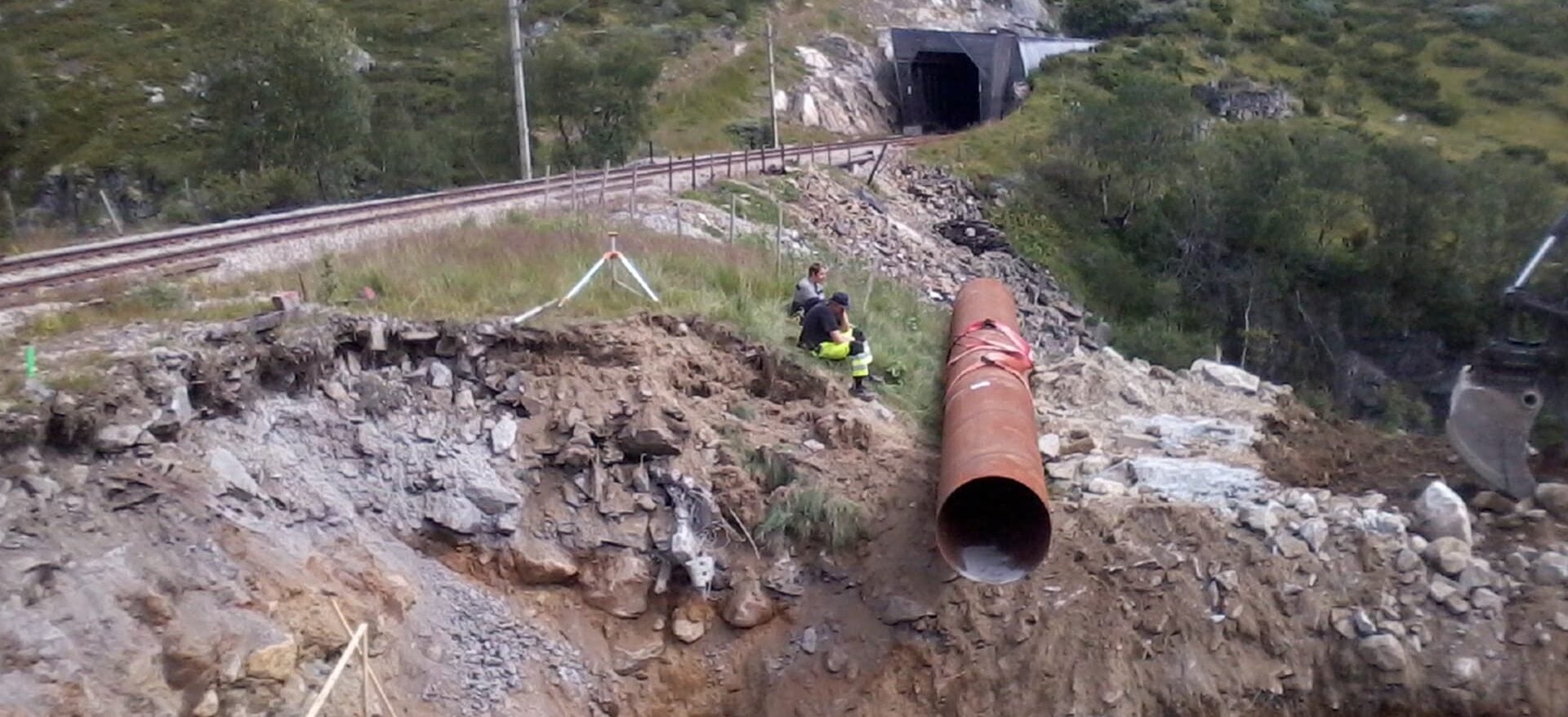
In 2019 the Geonex system received NASTT’s Innovative Product of the Year Award and to date over 50 Geonex systems have been sold to Finland, Sweden, Norway, Israel, Switzerland, Austria, USA, Canada, Germany, Spain & Portugal. Scandinavia remains the most popular market where HHB is used for around 80 percent of 5.5-inch to 48-inch cased trenchless crossings < 500 feet in length, most bores are installed through terrain with frequent boulders. In Norway bores mainly run through strong to extremely strong 50,000+ psi unconfined compressive strength rock. In Switzerland the versatility of the system has been recognized and Geonex has been nominated for projects to minimize the risk of bore failure due to unforeseen natural ground conditions, it is also being unusually used to excavate catacomb graves in Israel.
The equipment from Finland is gaining traction and acquiring a reputation of “once used or seen never forgotten”. Orders are being placed without work in-hand and customers are moving to purchase additional units after delivery of the first.
For Kimmo, supported by Tuomas Lassheikki and an ever-increasing work team product development is not over. Whilst writing the article a trial has been undertaken in Finland with an actively steerable 8-inch guided pilot casing that is to be reported under separate cover as is the factory test and field trial using mechanically interlocked steel casings that can offer an alternative to site butt joint welding of casings.
DTH and HHB hammers are not new to market, but the cleverly adapted Geonex package certainly is and offers ease of market entry to customers. For engineers and contractors, it puts on the table a “go to solution” for the installation of small diameter tunnels in the “rock and the hard places”.