


Geonex HHB enables cost-efficient steel casing installation in mixed rock and boulder soils—without thrust walls, fluid support, or grade loss.
Introduction
Geology has a significant influence on trenchless casing installations. One of the most challenging ground types is mixed geology with abundant boulders and cobbles. Combined with shallow bedrock intersecting the bore path, this creates complex conditions for casing installation. When boulders are larger than the casing itself or cannot be displaced, selecting the right method becomes essential.
Choosing the Right Method
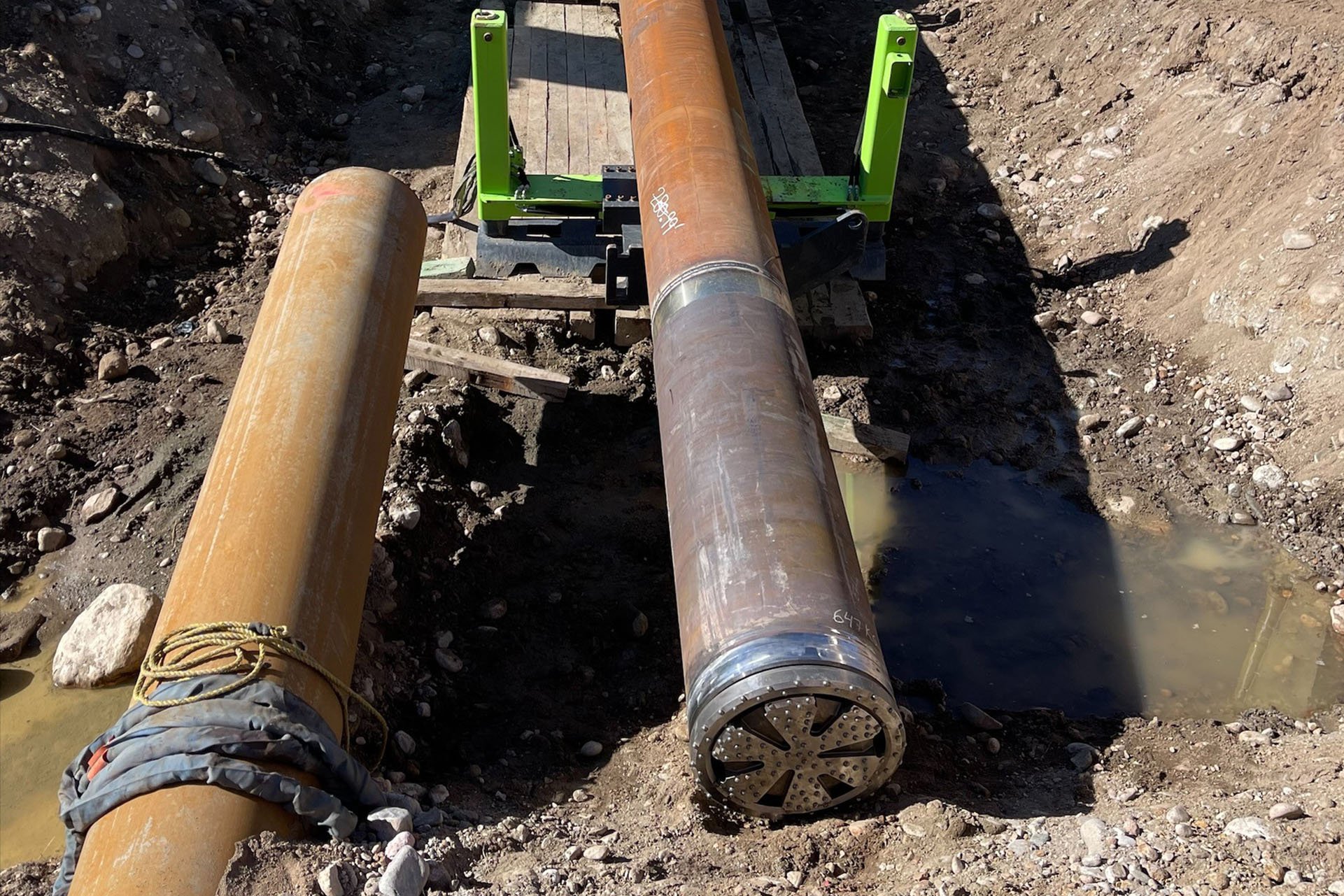
Choosing the correct trenchless method affects the entire process—from engineering to surface reinstatement. In these conditions, the most common alternatives include HDD, pipe ramming, auger boring, pipe jacking/microtunneling, and Horizontal Hammer Boring (HHB). Geonex HHB is particularly effective for casing diameters between 5½” and 48”, with bore lengths under 350 ft. Many traditional methods require jacking forces, reaction walls, or precisely leveled and sometimes concrete-based pits. Geonex HHB eliminates these requirements. The casing is pulled into place by an air-powered hammer, and boring alignment is adjusted with hydraulic jacklegs. No thrust walls or exact pit leveling is necessary.
In complex ground, casing diameters are sometimes oversized to compensate for misalignment or difficult conditions. With HHB, smaller diameters can often be used effectively. Even 5½” casing can succeed where larger tools would otherwise be required, saving material and space.
Bore Length and Grade Control
HHB follows a pit-to-pit principle and does not require slope-down and slope-up geometry like HDD. This enables shorter boring distances and better use of space. For projects with critical grades, trenchless sections should be completed before open cuts to allow for fine-tuning later. HHB maintains a steady workflow. The same drill head is used across varying soils without changing tools or switching to hand tunneling. Penetration rates remain high even in 50,000 PSI granite, and consumable costs are low compared to disc or claw cutters.
Surface Stability and Final Accuracy
Since the Geonex system pulls casing with minimal overcut, it avoids surface settlement and heave. It displaces no material and supports the bore from start to finish. For the best accuracy, downhill boring is recommended, and long casing elements help reduce welding and maintain line consistency.