


Delivering alternate solutions
Expecting the unexpected is the status quo for the trenchless industry. Designers and Contractors alike carefully evaluate project parameters to develop a plan utilizing the known methods to achieve success. Furthered by collaboration between equipment manufacturers and industry professionals, the approach and solutions to anticipated project hurdles are ever-evolving. The unknowns, especially in trenchless construction, can be disastrous to a project plan and budget, but have led to some of the most creative solutions that were once considered to be novel, have become tried and true industry standards. In this article we’ll focus briefly on a few examples of North American projects that turned to Horizontal Down-Hole Hammer Boring for success.
Horizontal Down-Hole Hammer Boring is a trenchless method for new installations which utilizes a pneumatic hammer and tooling located within the lead casing. Each stroke of the hammer accelerates heavy steel tooling forward which both pulverizes the subgrade as well as advance the casing installation by “pulling” the casing into place from the front, not pushing from the rear. Compressed air is then released, conveying the pulverized material through openings in the face of the tooling, back into the steel casing where it is carried back to the launch pit by rotating auger. This method can be successfully deployed in ground consisting of solid bedrock, intermittent cobbles as well as mixed conditions without having to change tooling for differing conditions. The diversity of conditions in which the method is successful has led to several recent projects turning to Horizontal Down-Hole Hammer Boring when traditional methods have been unsuccessful, restricted, and where anticipated risk encouraged seeking an alternative solution.
Alternative to Auger Boring
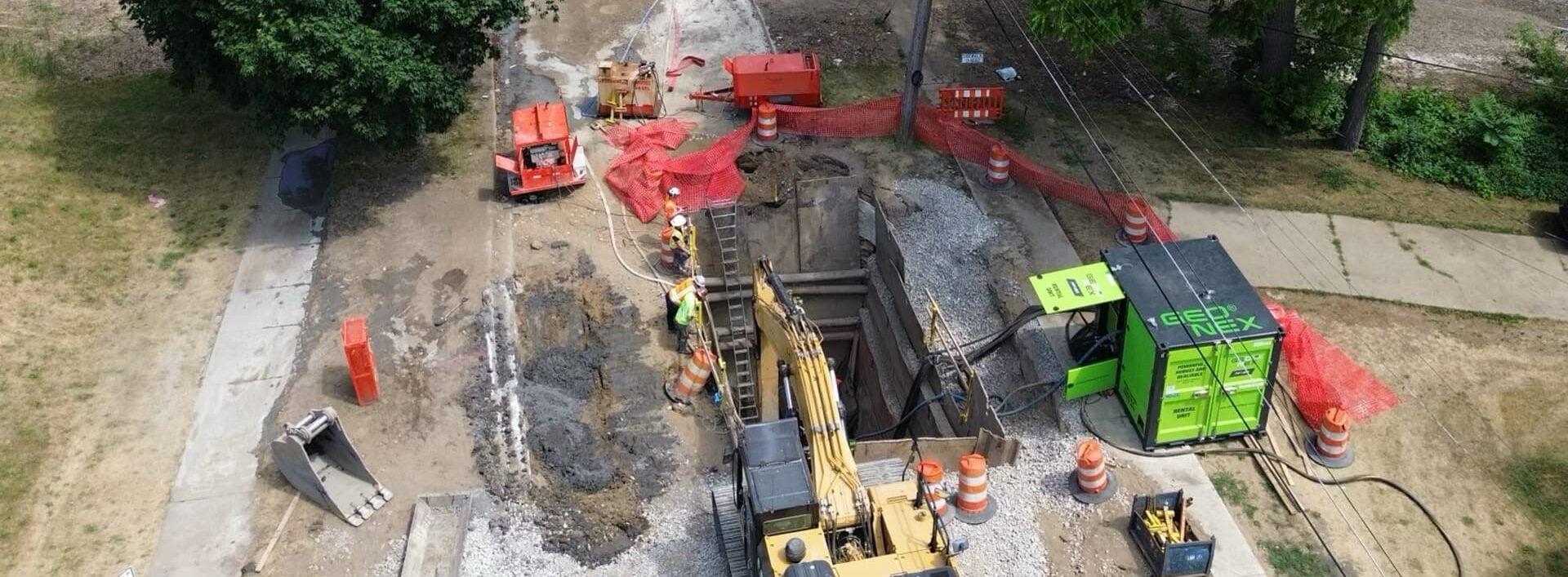
In June 2023, Dunigan Brothers of Summit Twp, Michigan set out to install 140 feet of 24-inch steel casing for a 12- inch Waterline below a pair of high-speed Amtrak rail lines. Familiar with the area and observing the topography, Dunigan anticipated cobbles and wet conditions in the 14-foot deep bore. “When you look at the site, it looks like the railway is laid in an old creek bed. We knew it would be wet and sloppy but had a feeling we’d hit rock so we made sure we had a back-up plan” said Patrick Dunigan II, VP of Operations at Dunigan Brothers Inc.
During the excavation of the jacking pit, Patrick’s feelings were confirmed when they began pulling rounded cobbles up to 24 inches in diameter from the pit. Under the direction of the project owner, Dunigan proceeded with traditional auger boring but was only able to make it about 13 feet before hitting the cobbles. “I reached out to GEONEX Inc. for rental pricing as a contingency plan before we even started digging. After reviewing the project details, they were certain they could be successful barring any steel obstructions. When we hit the cobbles, I confirmed pricing, presented a change to the owner, and with minimal delay, GEONEX Inc. was on-site with their technician and tooling to get this project back underway.” explained Patrick. “We could only accommodate 10-foot casing lengths so it took a little while to make all those welds and we finished the bore in 4 days. I was impressed how well the equipment performed in the sloppy soft spots as well as through the cobbles.”
Alternative to Micro-Tunneling
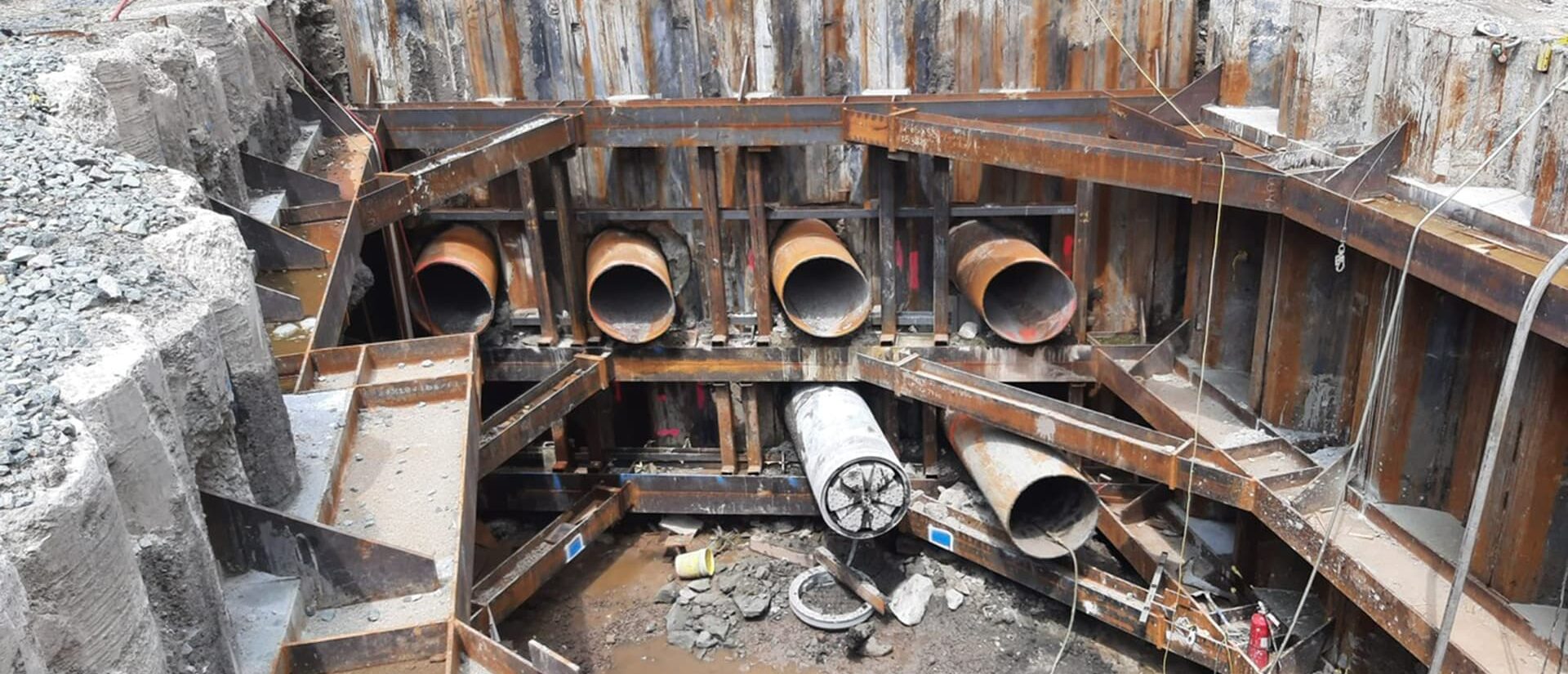
For a project in Jersey City, NJ, Northeast Remsco Construction (Remsco), a JAG Company, was contracted to perform (8) parallel 36-inch diameter micro-tunnels below the NJ Transit Light Rail which would house electric conduits. While preparing the site, it was discovered that the ground below the bore path consisted of vastly differing conditions, which were not suitable for the MTBM. In addition to being below the water table, soft soils and occasional cobbles were revealed, as well as an abandoned concrete duct bank and a cast-iron water main. As the contract prohibited the use of other common methods, Remsco began evaluating the feasibility of the Horizontal Down-Hole Hammer Boring method.
Remsco Project Manager George Gutierrez P.E. talks about the turn of events. “When we reviewed the additional information, we immediately conveyed our concerns to our client Yonkers Contracting Company. While waiting to discuss solutions with the Port Authority, we went through process of elimination for the other methods we perform; Auger Boring, HDD, Microtunneling, and pipe ramming. We’ve been interested in the GEONEX systems for Horizontal Down-Hole Hammer boring and began evaluating it further. A joint meeting between Remsco, GEONEX and the project owner led to a preliminary approval. Once the owner approved, GEONEX expedited production and delivery of their HZR1200 drill machine which is capable of up to 48-inch casing installations. We accepted delivery in May 2024.”
Currently all 8 installations are complete. “We always want what is best for the project, and we were fortunate all involved let us employ an alternate method. Now that we have the GEONEX system, we’ve been looking at how it can improve success for other upcoming projects,” said Gutierrez.
Alternative to pipe ramming
In March of 2024 Horizontal Down- Hole Hammer Boring was utilized to successfully install 320 feet of 42-foot casing in the mountains of Southwestern VA. Three significant hurtles made this critical installation challenging. First, the 42-inch bore would proceed 105 feet, crossing an active NSF railway. Second, the remaining 215 feet would be below a shallow creek that is habitat to a U.S. Fish & Wildlife classified Threatened species of fish. And lastly, this installation would have to be performed through ground consisting of cobbles the size of a V8 engine block.
The stakes were high. Not only had previous attempts with roller cone auger boring heads been unsuccessful, but additional attempts utilizing small diameter pipe ramming had also failed. Additionally, inadvertent returns of air from pipe ramming could create turbidity in the stream, which could have a significant impact and potential harm to the threatened species.
Project owner Equitrans Midstream was open to suggestions. HDD and Slurry Microtunneling were considered, however both the cobbles and potential for IRs eliminated these options. Mike Kidd of Atlantic Underground presented the idea of using Horizontal Down-Hole Hammer Boring. The method does not require bentonite, is proven successful for cobble conditions, and because the air flows back through the casing, the potential for creating turbidity in the creek was significantly reduced.
After exhaustive planning, preparation, and cross-checking data, Atlantic Underground was asked to mobilize to the site by March 18. “Once the pit was excavated and trench boxes were in place, the GEONEX machine was set in the launch pit, air compressors connected, and the first casing set to install. It took 5 days to complete the bore, with a couple of long nights spent completing the 4 to 5 hours of welding per joint. 40-foot lengths of casing were installed at an average rate of 17 feet per hour, yielding 80 feet per day. ”Once the crossing was complete, the product pipe was slick-bored into place,” said Kidd
An Equitrans representative indicated there were over 350 bores on the project through the same type of ground. “Knowing what we know now about the Horizontal Down-Hole Hammer Boring method and GEONEX, we could have utilized this method on several challenging bores and saved months on the project.”