


Minger expands trenchless reach with HHB tech, tackling tough soils and growing beyond Minnesota while staying family-focused and future-ready.
Minger Invests in HHB Tech
Minger Construction company commitment to be the Go-To regional contractor for complex trenchless works by investing in Down Hole Horizontal Hammer Boring (HHB). Already a staple in the Midwest for their capabilities and commitment to growth in underground utility construction, in 2022 Minger Construction began discussions with GEONEX, the Finnish manufacturer of complete Down Hole HHB systems. The goal was to expand their abilities and improve efficiency for the rocky ground they encounter.
Jordan MN based Minger Construction was started by Patrick Minger in 1984 with a backhoe, pick-up truck, and his wife Karen. Today, Minger construction has grown to over 100 family members and is led by Patrick’s son Luke Minger. Bonded by their shared values, the Minger team is not blood relatives, but rather made up of a team that Luke describes as a family. “Family is very important at Minger Construction. We want people to feel like they are part of the team and not just a number.”
Minger Grows Beyond Minnesota
Minger operates primarily in central Minnesota. However, as they have grown so too has their geographic foot print which has brought them as far West as Utah and South as Iowa. Expansion into new territories allowed Minger the opportunity grow, continuously expanding their trenchless capabilities as well. Utilizing a variety of trenchless construction techniques which includes Tunnel Boring Machines, Guided Boring Equipment, Auger Boring, Directional Drilling, Pipe Ramming, has allowed Minger to adapt and be successful throughout their footprint and in a variety of ground conditions. Minger construction has capabilities from 16 through 180 inches diameter, making them well equipped to handle most any project.
“The trenchless industry is ever changing. To maintain a competitive edge, we have to stay up to date with new technologies, adding different options and methods into our tool box. Being proficient with each method and having them at our fingertips allows us to complete challenging projects. This allows us to keep moving forward and onto the next project for our owners and clients.” explained Luke.
Navigating the Challenges of Rock Boring
It’s all about mitigating risk and balancing costs. To be successful in the trenchless industry you have to be able to get through the ground and do it with pricing that can win you the job but not lose money. Each soil condition presents its own set of challenges. Most rock boring occurs at a snail’s pace compared to other soils. Not only slower, but in most rock installations, contractors are left with little options other than to increase diameter to permit manned entry. Rock wears out cutting heads, sloped bedrock can push a contractor off course, and cobbles can jam up augers.
Overcoming Rock with Down Hole HHB Technology
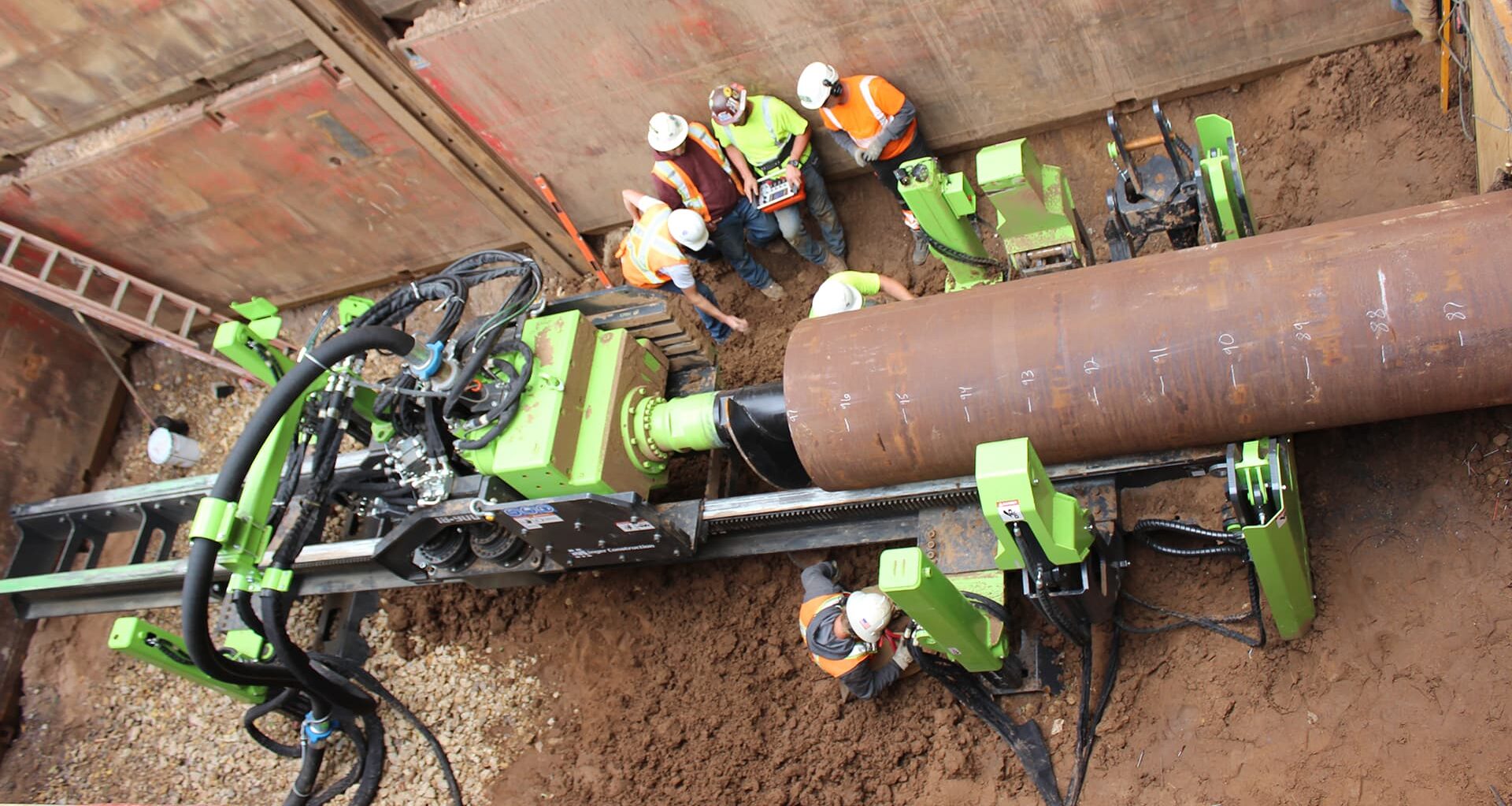
Down Hole HHB utilizes a pneumatic hammer located close to the face. A bit is accelerated which fragments large rock into smaller particles with linear action. Compressed air is released at the face blowing cuttings back to rotating auger. With each cycle of the hammer, the casing advances as the ground along the bore path is broken up, allowing for advancement rates in excess of 10 feet per hour even through very hard rock.
Down Hole HHB is not without its own limitations. The method relies on the integrity of the down-hole components to withstand the hammer forces. Without lubrication, skin friction becomes a limiting factor on installation length. The components are not cheap either. However, when compared to the alternatives of increasing diameter, increased risk and slow installation rates, the HHB method is ideal for crossings up to the 330 foot range and has been successfully deployed for longer installations.
“Rock has always been a challenge and the traditional approaches typically required increasing diameter and a very big risk factor. We had the opportunity to see the GEONEX Down Hole HHB boring systems in action a few years back when we hired EBI drilling services of Duluth MN, to use their GEONEX equipment on a few small diameter bores for us. We were really saw the value in the technology and began evaluating the benefit it could have provided on a few previous projects where cobbles and boulders kept us on site longer than we wanted to be.”
Investing in GEONEX for Efficiency and Versatility
In January 2023, looking ahead at a few potentially troublesome projects Minger Construction took the next step forward in their growth with purchasing a GEONEX HZR1200 boring machine and the newly re-designed PP205 Hydraulic Powerpack. The HZR1200 bore machine is capable of diameters up to 48 inches and with the same cutting head, can be successfully utilized in a variety of ground conditions giving Minger the ability to perform installations through varying rock, clay, and sand along the same bore path. Luke explains a bit of their decision making process, “We had a few projects coming up that we knew were going to be tough due to the soils reports. We evaluated installation rates of some previous projects and compared it to what the Down Hole HHB method could offer. Having witnessed the GEONEX equipment in action we were convinced our investment would pay dividends relatively quickly based on the time savings and risk mitigation by going with the GEONEX system.”
First HHB Project Puts New Equipment to the Test
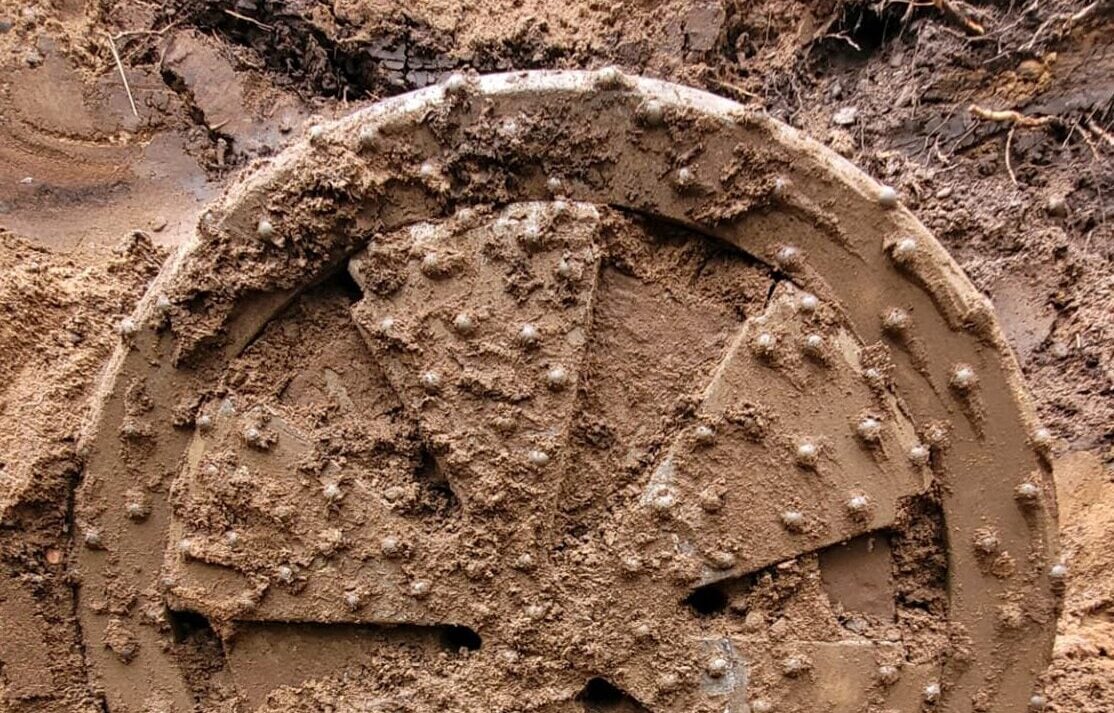
In June 2023 Minger took delivery of their new equipment, including components necessary to complete their first planned project using the Down Hole HHB method. MNDOT Project 8210- 115 TH 95 called for the installation of 240 feet for a new 36-inch diameter steel culvert under State Highway 95 in Scandia MN. Initial site investigation revealed boulders and cobbles on the downstream side of the installation. Excavation of the jacking pit on the upstream side of the culvert however revealed only small amounts of rock. The differing conditions from one end of the bore to the other became more evident during installation. The first 60 feet saw transition from a sandy clay loam to thick heavy brown clay. The clay went on for another 100 feet with intermittent rock fragments appearing in the spoils pile.
As Luke describes, “We were getting about 20 feet an hour, then stopping to weld. It was going pretty fast but from what we could tell we weren’t hitting any rock yet. At 180 feet in, we pulled the auger, hammer, and pilot bit to check elevation and see what the soils were at the face. We found a rock that was about 16 or 18 inches long just waiting to be broken up. We moved a little dirt and revealed even more rock.”
Faster Results and New Opportunities with HHB
Minger bid the project under the conventional design which called for pipe jacking with an anticipated 6 to 8 week duration. Performing value engineering with the DOT, Minger was successfully able to receive approval for the Down Hole HHB method with their new GEONEX system, which was utilized to complete the installation in under 2 weeks. Although the Down Hole HHB approach is a non- guided method, accuracy was achieved by assistance from GEONEX technicians during the work, resulting in a nearly perfect downstream invert and location.
“At Minger Construction we want to continue to grow by keeping up with new technologies and different equipment options that are out there. We feel the GEONEX system will allow us to enter some new markets and handle ground conditions that we would have taken a hard pass on before because we were scared to fail. I am excited at the opportunities that are out there and look forward to giving owners and clients another option to successfully complete trenchless pipe installation in challenging soils!”