


High-Speed Pipeline Delivery Amid Colorado’s Mountain Challenges
To meet the needs of rapidly growing resort communities in Colorado, two existing natural gas pipelines required interconnection with a new 1.5 mile 6-inch, high pressure line. In July 2021, Blackeagle Energy Services of Berthoud CO was contacted by their client to construct the interconnection, which needed to be complete by winter 2021. “Residential construction growth in Colorado is occurring at breakneck speed, faster that most gas companies can keep up.” Said Erik Hepker, Field Services Manager for Blackeagle. “This would normally be a 2 – 3 year project for design and construction. In July 2021 design was not finalized. It would be design as you go and were up to the task.” In addition to only having 4 months to complete the project, several other challenges made this new installation even more complex. Traversing hiking and biking trails, a 600- foot elevation change in the 1.5 miles, survey, clearing, material procurement, soil investigations, and coordination with Army Corps of Engineers, the installation, testing and putting the line into service by October 2021. Adding further difficulty, the proposed path included crossing the Fraser River at a Fen Wetland, a crossing which saw 9 design reiterations before being finalized.
Precision Boring Protects Sensitive Fen Wetland
A Fen Wetland is a peat-forming wetland that relies on groundwater input and requires thousands of years to develop. The ecological functions of fen wetlands cannot be easily restored once disturbed, thus, selecting techniques with minimal disturbance was paramount consideration when choosing the methods for crossing the fen. Installation of conductor casings is a common technique in directional drilling when encountering gravel and cobbles at the entry pit. Conductor casing provides a mechanism to mitigate inadvertent returns and maintain good flushing of the bore hole. Setting drilling operations back from the fen wetland prevented surface damage, but to prevent subsurface damage the need to protect the wetland from inadvertent returns from below also had to be considered.
Soil borings along the proposed path revealed a cobble layer about 50 feet deep before hitting bedrock. Drilling would need to go 240 feet at a 12-degree entry angle before hitting bedrock at a 12-degree entry angle. Utilizing the GEONEX™ downhole hammer boring system allowed trenchless contractor NewTech Drilling of Nebraska City NE to install the conductor casing twice as long as traditional hammer boring methods would allow. Installing 300 feet of conductor casing provided NewTech with the ability to get through the cobbles and boulders and established into bedrock. This approach provided significant benefits to the 2,200 LF HDD installation by mitigating inadvertent returns as well as being able to avoid having to steer the HDD through the cobbles and boulders. Once into the bedrock NewTech would drill another 50 feet in elevation before beginning to steer upward to hit an exit angle of 16 degrees at El. 9,131, nearly 2,200 LF away.
NewTech Chooses GEONEX™ for Pipeline Breakthrough
Blackeagle selected NewTech Drilling of Nebraska City, NE to perform the trenchless works. “We have done a lot of work for Blackeagle, in some really challenging conditions.” said NewTech’s president Brandon Olson, they trusted our expertise and opinion in selecting the best approach.” Olson had been researching GEONEX™ for a while. “We really struggled on a project in Steamboat Springs a few years ago, and I knew there had to be a better way to deal with cobbles and boulders. I found GEONEX™ online, spoke with them and believed their technology was the answer.”
NewTech met with Blackeagle and the pipeline owner to discuss using GEONEX™. “The project schedule was too tight to wait for a new Geonex system to arrive from Finland where GEONEX™ manufactures their equipment, but they were great to work with. They (GEONEX™) helped coordinate a rental and technician with one of their clients in Minnesota.” said Olson. To install the 300 feet of 24-inch conductor casing, the GEONEX down-the-hole (DTH) Horizontal Hammer Boring (HHB) solution presented the best opportunity for success.
GEONEX™ System Enables Precision Bore Through Tough Terrain
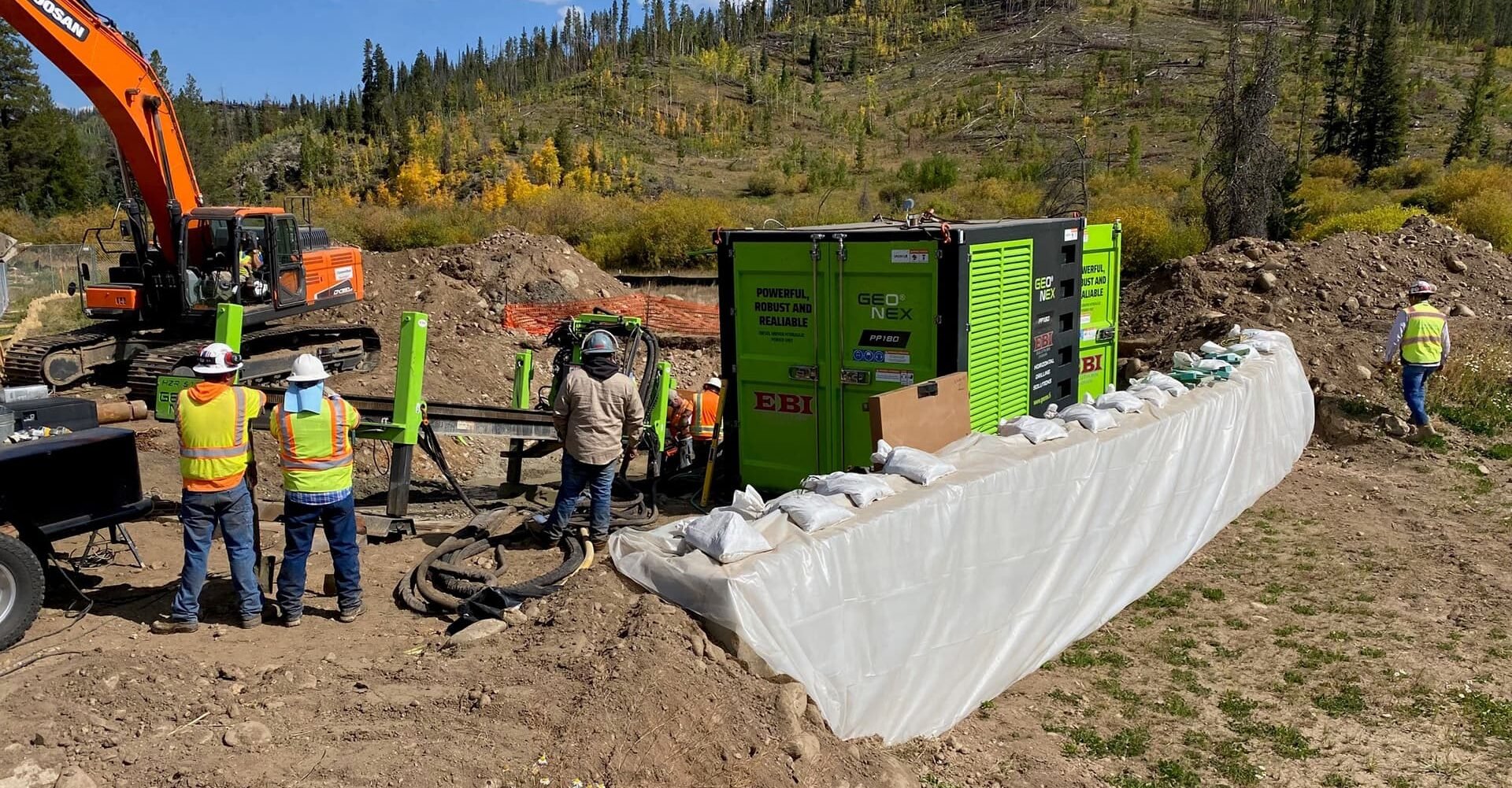
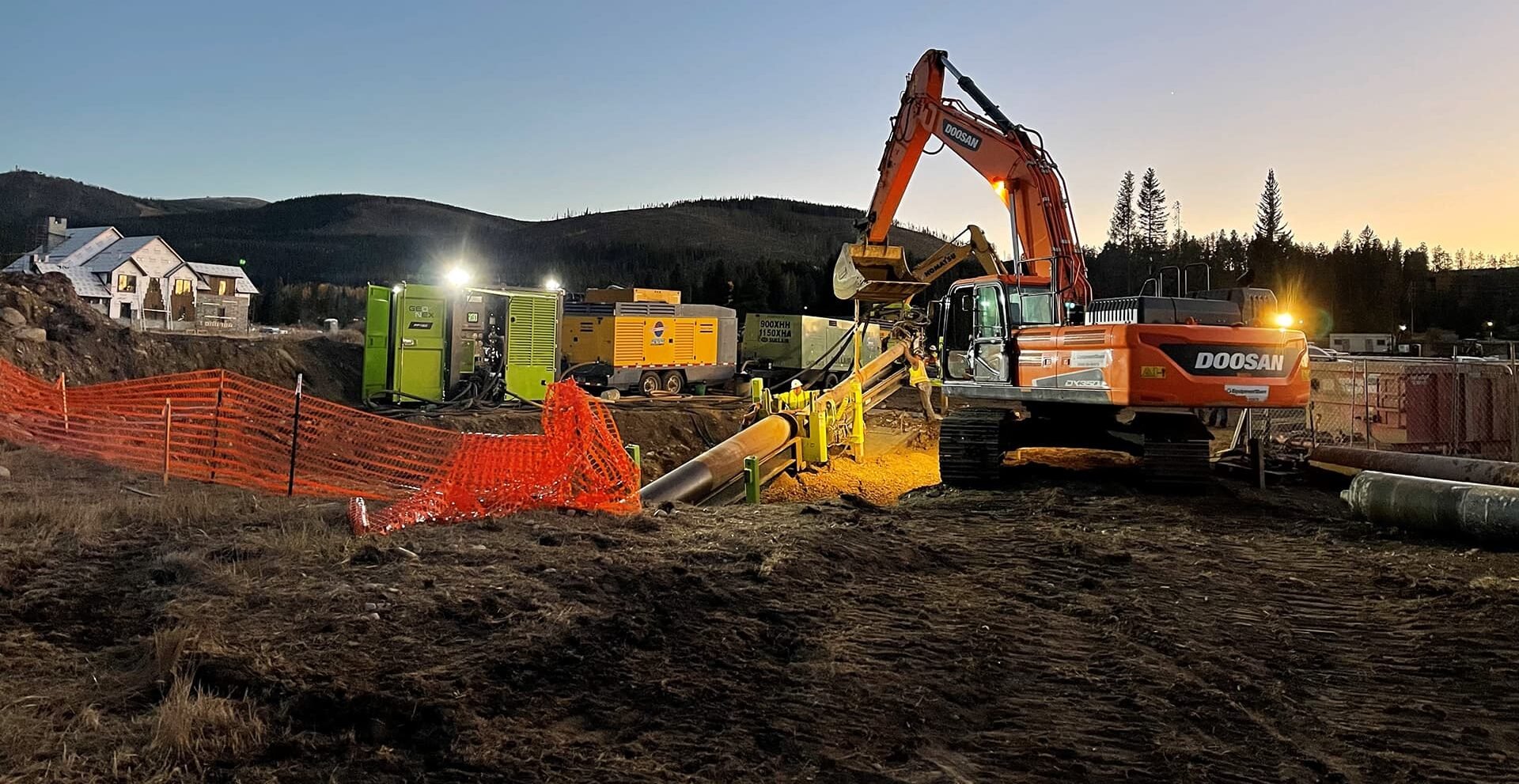
The GEONEX™ system is an umbilical system consisting of 3 main components, a drill machine, hydraulic power pack, and air compressors. The drill machine which provides rotation for auger and the means of conveying air to the downhole hammer at the face of the steel casing is placed in the launch pit. The Hydraulic power pack sits on grade and provides power to the rotary system and other hydraulic components, air flow regulation, and the brains for wireless remote control. Air compressors to meet the air requirements of the downhole hammer were placed on site and connected via hosing to the powerpack. The GEONEX™ Down-The-Hole horizontal boring system does not require the use of drilling fluids, which further served as benefit to mitigate impacts to the fen wetland.
“While coordinating and planning for the drill, we were installing the 6-inch gas main on either side of the bore path,” said Hepker, “so we were really counting on the crossing going well. There was no margin for error.” The GEONEX™ HZR610 was adjusted via independent hydraulic legs to meet the desired 12 degree entry angle. Because the downhole hammer and auger string would be removed to accommodate the HDD drilling components, the lead section of casing was fitted with an integrated ring bit to prevent the ring bit from becoming an obstruction once the hammer is removed. The process of installing 300 LF of 24-inch casing through the 50-foot thick layer of cobbles and boulders and terminating in bedrock took approximately 2 days to complete.
GEONEX™ Launch Sets the Stage for 2,200-Foot Precision HDD Success
Upon completion of installing the conductor casing and retraction of the auger and hammer, air and hydraulic hoses between the GEONEX drilling unit and the powerpack were removed and the drill machine pulled from the launch pit. Next, a 16-inch steel casing with centralizing legs was slid inside the conductor casing to aid in centering the HDD tooling. NewTech utilized their Vermeer D330x500 accompanied by a 14-inch bit with centralized mud-motor for the 2,200 LF pilot drill. “We used a wireline for steering.” said Olson. “You can’t get a reading until you’re out of the casing because of magnetics. The 24-inch casing was within ½ degree vertically and 2 inches horizontally from target, so we were very pleased with how the GEONEX™ system performed, and it gave us a great start to our drill.”
NewTech completed their 2200 LF pilot drill in 6 days, on target and keeping the project moving at the pace it needed to achieve schedule. After pulling back the 6-inch steel gas main, Blackeagle quickly wrapped up the tie-ins, completing testing and putting the line into service before the first snow falls.
“We were really proud of the work” said Hepker referring to the project team. “We have a few more projects coming up which we plan on utilizing the GEONEX system.” After the project, NewTech, purchased the first of now three GEONEX™ systems in their fleet. “I was really impressed by how the GEONEX™ system performed. We now have the capabilities to go from 5-1/2-inch casings up to 32 inches with our equipment. We have both power packs, the HZR 610, HZR400 and our HZR220 should be here soon. I don’t expect to see these machines in our yard too often.”